
Last updated: September 27, 2026
When your heating or cooling stops working right, the fix can be as simple as a thermostat setting, or it can be a failing part that needs a trained technician. Knowing the difference saves you money on unnecessary service calls and keeps you from ignoring a problem that's getting worse or unsafe.
Below are the most common HVAC problems and issues Vancouver homeowners run into, organized by symptom, so you can spot the signs you need HVAC repair early. Each one covers what you can safely check yourself and when it's time to call a professional.
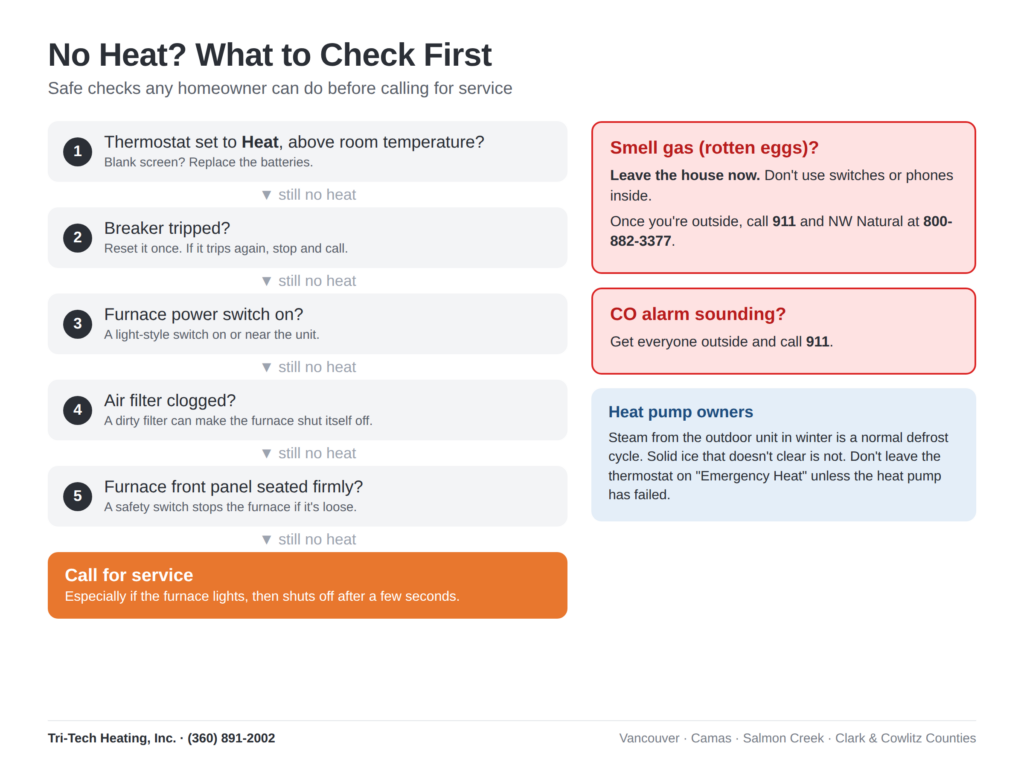
Safety first: stop and call right away if…
Some situations aren't troubleshooting problems. Act on these immediately:
- You smell gas (a rotten-egg or sulfur odor). Leave the house right away. Don't use light switches, phones or anything that could spark while you're inside. Once you're outside and away from the house, call 911 and NW Natural's 24-hour emergency line at 800-882-3377.
- Your carbon monoxide alarm sounds. Get everyone outside into fresh air and call 911. Don't go back in until responders say it's safe. Have your gas appliances inspected before using them again.
- You smell burning plastic or electrical burning, or see smoke or sparks. Shut off power to the system at the breaker and call for service. A dusty smell the first time the heat runs each fall is normal and fades within an hour. An electrical burning smell is not normal.
- Water is pooling near electrical components. Turn off power to the unit before doing anything else.
No heat
Check first:
- Thermostat: Make sure it's set to Heat, the setpoint is above room temperature, and the screen is on. Replace the batteries if it has them. A blank screen is one of the most common "no heat" causes.
- Breaker: Check your electrical panel for a tripped breaker for the furnace, air handler or outdoor unit. Reset it once. If it trips again, stop and call.
- Furnace switch: Most furnaces have a light-switch-style power switch on or near the unit. It sometimes gets flipped off by mistake.
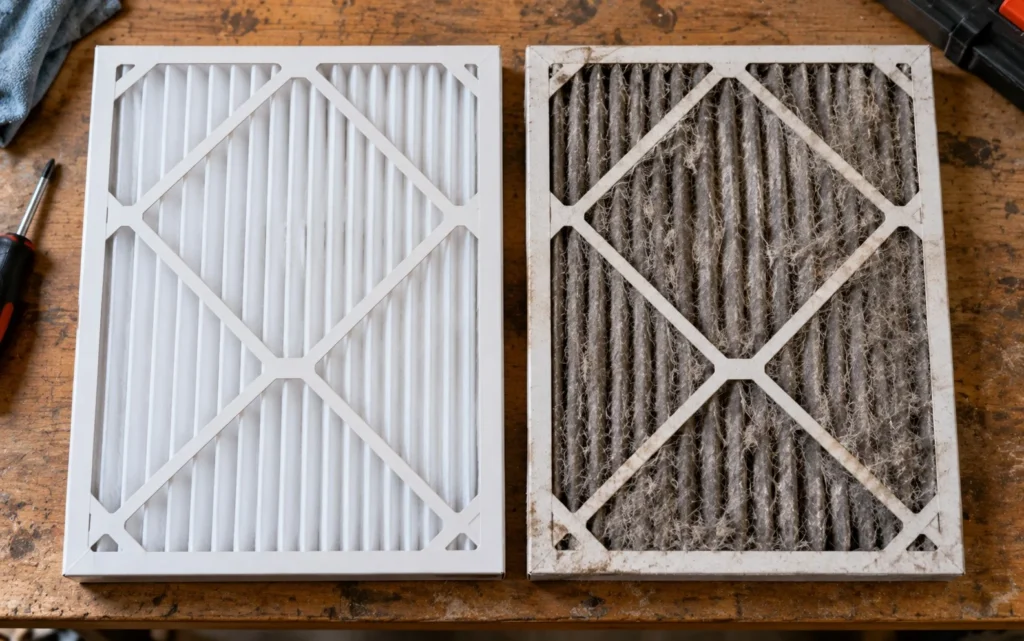
- Filter: A badly clogged filter can make a furnace overheat and shut itself off as a safety measure. Replace it if it's dirty.
- Furnace door: The front panel has a safety switch. If the panel isn't seated firmly, the furnace won't run.
- Gas supply: If other gas appliances aren't working either, the problem may be your gas service, not the furnace.
Call a professional if:
- The furnace lights, runs for a few seconds, and shuts off, over and over. This is often a dirty flame sensor or an ignition problem.
- You hear the blower but the air never warms up.
- The breaker trips again after one reset.
- A heat pump runs but only blows cool air in heating mode, or the outdoor unit is fully encased in ice (see below).
- You've checked everything above and still have no heat.
Heat pump iced over
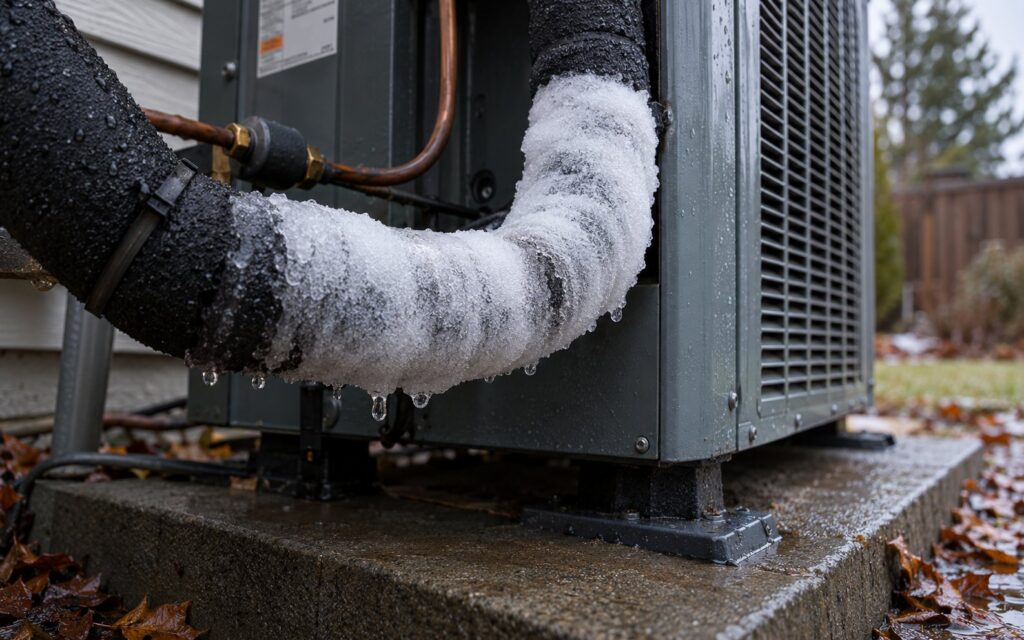
A thin layer of frost on the outdoor unit in cold, damp weather is normal. The heat pump runs a defrost cycle every so often to melt it, and you may see steam rising from the unit. That's defrost doing its job.
Check first:
- Clear snow, leaves and debris from around the outdoor unit and keep at least a foot of clearance on all sides.
- Make sure roof runoff or a gutter isn't dripping onto the unit and refreezing.
Call a professional if:
- The coil is solid ice, or the ice doesn't clear after a few hours.
- The fan is stopped or blocked by ice.
- The system is running on auxiliary heat most of the time in mild weather, which drives up your electric bill.
Regular service prevents most of these problems. See what a heat pump tune-up includes.
No cooling or weak cooling
Check first:
- Thermostat: Set it to Cool, with the setpoint below room temperature.
- Breakers: Outdoor units usually have a breaker in the panel and a disconnect switch near the unit. Check both.
- Filter: A clogged filter chokes airflow and makes cooling weak.
- Outdoor unit: Clear away grass clippings, cottonwood fluff and debris, and gently rinse the fins with a garden hose (not a pressure washer) with the power off.
- Vents: Make sure supply registers are open and return grilles aren't blocked by furniture.
Call a professional if:
- The indoor coil or refrigerant line is frozen. Turn the system to Off, set the fan to On to thaw it, and call. Ice usually means an airflow problem or low refrigerant, and low refrigerant means a leak, since refrigerant isn't used up.
- The outdoor fan is spinning but the compressor isn't running, or the outdoor unit hums without starting.
- It's running constantly on a mild day and still can't keep up.
See our air conditioning repair page for the problems we fix most often. For heating problems, see furnace repair in Vancouver WA and heat pump repair in Vancouver WA, and if it can't wait, emergency HVAC service.
Uneven temperatures and hot or cold rooms
Check first:
- Open all supply registers, including in rooms you don't use. Closing too many raises pressure in the ducts and can make the whole system work worse.
- Keep return grilles clear.
- Look for obvious drafts around windows and doors.
Call a professional if:
- One area is always much warmer or colder than the rest of the house.
- Some rooms get barely any airflow.
Common causes include undersized or disconnected ducts, leaky ductwork in a crawlspace or attic, or equipment that was sized wrong for the house. Solutions range from duct sealing to zoning to adding a ductless mini-split for a problem room.
Short cycling
Short cycling means the system turns on and off repeatedly in short bursts.
Check first:
- Replace the air filter.
- Make sure the thermostat isn't in direct sun, near a supply vent or next to a lamp or TV, where false readings can switch the system off early.
Call a professional if it keeps happening. Short cycling can point to an oversized system, an overheating furnace, a refrigerant problem or a failing control. Beyond the comfort problem, it wears out components quickly. See why sizing matters.
Strange noises
Some sound is normal: the click of the thermostat, the whoosh of air, the hum of the outdoor unit. These are not:
- A loud bang or boom when the furnace starts: often delayed ignition, where gas builds up before lighting. Call for service.
- Squealing or screeching: usually a blower motor bearing or belt.
- Grinding or scraping: a motor or fan problem. Turn the system off and call to prevent further damage.
- Rapid clicking without starting: an ignition or electrical problem.
- Buzzing or humming from the outdoor unit that doesn't start: often a failing capacitor or contactor.
- Rattling: a loose panel, or something caught in the fan.
Unusual smells
- Dusty or burning-dust smell on the first cold day: normal, from dust burning off the heat exchanger. It should fade within an hour.
- Musty or moldy smell: can mean moisture in the ducts, a clogged condensate drain or a dirty coil. Worth having checked, especially if anyone in the house has allergies or asthma. See our indoor air quality services.
- Rotten eggs: possible gas leak. Follow the safety steps at the top of this page.
- Burning plastic or electrical smell: shut the system off at the breaker and call.
Water leaking around the indoor unit
High-efficiency furnaces, air conditioners and heat pumps all produce condensation, which drains away through a line or a small pump.
Check first:
- Look for a clogged or disconnected condensate line, and check whether the condensate pump (if you have one) is running.
- Many systems have a float switch that shuts the system off when the drain backs up. If your system stopped and there's water in the drain pan, that's likely why.
Call a professional if the pan keeps filling, water is reaching the floor or ceiling, or the leak is near electrical parts.
Heating or cooling bills suddenly jump
Check first:
- Compare against the same month last year. Our winters vary, and utility rates change too.
- Heat pump owners: Make sure the thermostat isn't set to Emergency Heat. That setting runs only backup electric heat and can multiply your heating costs.
- Replace the filter, and check that no windows or vents were left open.
Call a professional if bills stay high with no change in weather or habits. Common causes include auxiliary heat running too often, low refrigerant, leaky ducts or equipment near the end of its life.
When repair stops making sense
A repair is usually the right call on a newer system. Replacement is worth considering when:
- The system is 15 or more years old and needs a major repair.
- Repairs are becoming a yearly event.
- It still uses R-22 refrigerant, which is no longer produced and has become costly to service.
- Your bills keep climbing, or comfort has never been good.
If you're weighing replacement, our HVAC upgrade guide and Heat Pump vs. Furnace in Vancouver WA cover options and operating costs, and the HVAC terms glossary decodes the language on quotes.
Are you in need of professional services for your home’s heating systems?
Contact Tri-Tech Heating, Inc. for expert solutions today!
Preventing most of these problems
Many service calls trace back to a handful of maintenance items:
- Change or clean filters every one to three months.
- Keep the outdoor unit clear of debris and vegetation.
- Keep supply vents open and return grilles unblocked.
- Test carbon monoxide and smoke alarms regularly.
- Schedule annual professional maintenance. A technician checks safety controls, combustion or refrigerant charge, electrical connections and the drains, which catches small problems before they become breakdowns. Tri-Tech Heating, Inc.'s Pre-Paid Preventative Maintenance Program (ESA) keeps that service on a regular schedule. See our seasonal maintenance checklist.
Need a technician?
Tri-Tech Heating, Inc. repairs and services furnaces, heat pumps, air conditioners, ductless systems and more across Vancouver, Camas, Salmon Creek and Clark, Cowlitz and Skamania Counties and the Portland metro area. Our work is 100% guaranteed.
Our office is open Monday through Thursday, 8:00am to 5:00pm, and Friday, 8:00am to 4:00pm, and a call to (360) 891-2002 during those hours reaches a person. The office is closed on Memorial Day, July 4, Labor Day, Thanksgiving and the day after, Christmas Eve, Christmas Day and New Year’s Day. After hours and on holidays, call the same number and a live person from our answering service will take your information. They'll text our on-call technician right away, or, if you'd rather wait, pass your request to our office and we'll respond by 9:00am the next business day. You can also contact us online. Licensed HVAC #TRITEHI952LL, CCB #161426.
Are you in need of professional services for your home’s heating systems?
Contact Tri-Tech Heating, Inc. for expert solutions today!
Frequently Asked Questions
Can I add refrigerant to my AC myself?
No. Handling refrigerant requires EPA certification, and low refrigerant means there's a leak that needs finding and repairing. Topping it off without fixing the leak only delays the problem.
How often should I replace my air filter?
Every one to three months for most standard filters. Check more often in wildfire smoke season, during heavy use, or if you have pets.
What are the signs you need HVAC repair?
The most common signs your HVAC system needs repair are no heat or weak cooling, short cycling, strange noises, unusual smells, water around the indoor unit, rooms that won't stay comfortable and a sudden jump in your energy bills. A burning or gas smell, or a CO alarm, means stop and call right away.
When should I call an HVAC professional if my AC is not cooling?
After you check the thermostat setting, the filter and the breaker, call if the air still isn't cool, the outdoor unit isn't running, or you see ice on the refrigerant lines. Those usually point to a refrigerant leak, a failed part or an airflow problem that needs a technician.
Company Information
Tri-Tech Heating, Inc.
6406 NE 116th Ave Unit C
Vancouver, WA 98662
Phone: (360) 891-2002