

Last updated: September 27, 2026
Most heating and cooling breakdowns don't come out of nowhere. They start as a clogged filter, a dirty flame sensor, a slow refrigerant leak or a blocked drain, the kind of small problem routine maintenance catches early. Regular maintenance also keeps your system running at the efficiency you paid for and helps it reach its full lifespan.
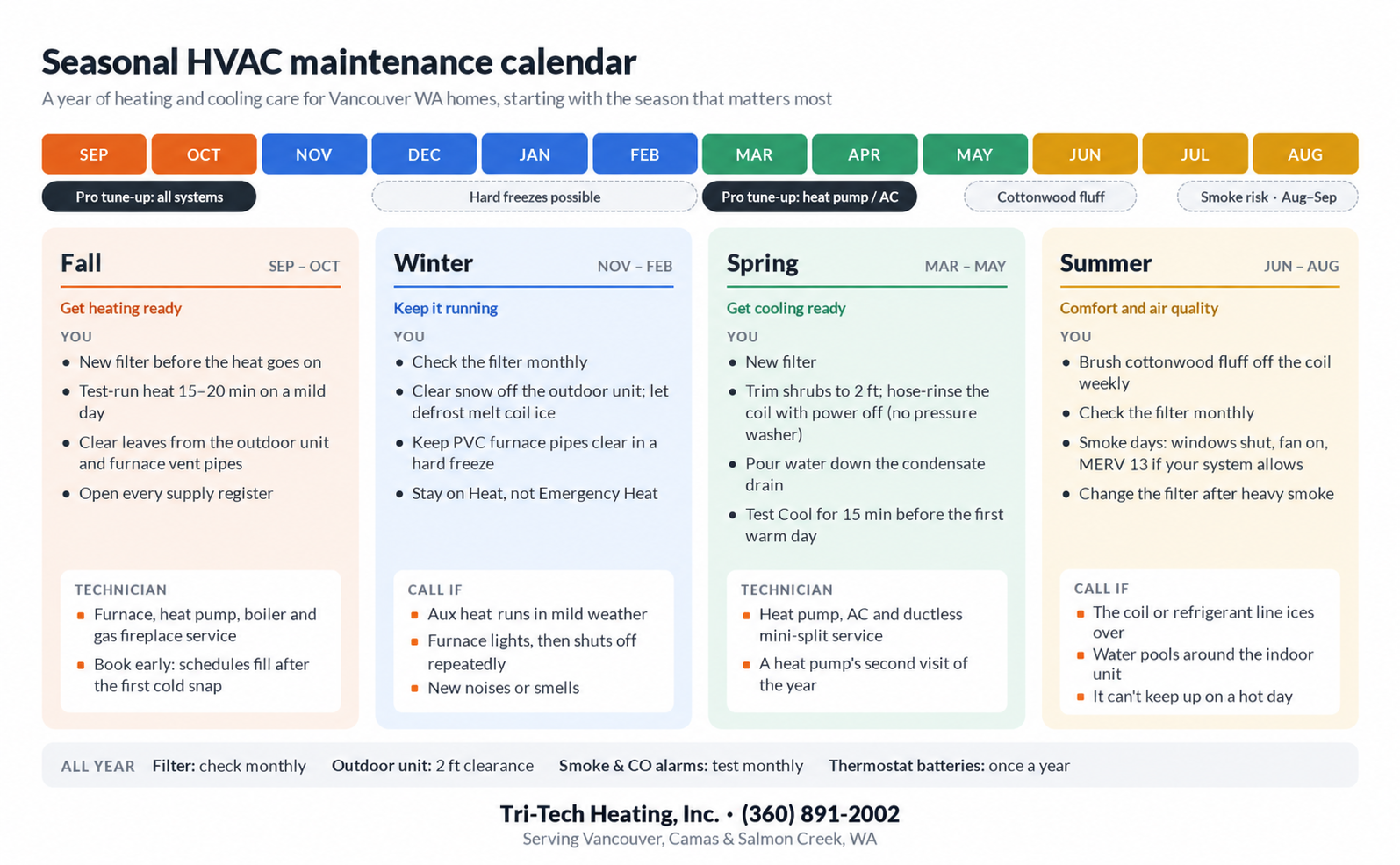
This checklist follows Vancouver's seasons: wet falls, a few hard freezes each winter, cottonwood fluff in early summer and wildfire smoke in some Augusts and Septembers. Each season lists what you can handle yourself and what a professional should check.
Year-round basics
These apply no matter the season:
- Check your air filter monthly and replace it every one to three months, or more often with pets, allergies, construction dust or smoke. The U.S. Department of Energy notes that replacing a dirty filter can lower an air conditioner's energy use by 5% to 15%.
- Keep supply vents open and return grilles clear. Furniture, rugs and curtains over returns starve the system of air.
- Keep two feet of clearance around the outdoor unit, and keep the area around your furnace or air handler free of storage.
- Test smoke and carbon monoxide alarms monthly. Every home with gas appliances or an attached garage needs working CO alarms.
- Replace thermostat batteries once a year. Changing them when the clocks change in the fall makes it easy to remember.
Fall HVAC maintenance checklist (September–October)
Fall is the most important maintenance season in the Northwest. Heating runs for months here, and service schedules fill fast after the first cold snap.
Do it yourself:
- Replace the air filter before you turn the heat on for the season.
- Switch the thermostat to Heat and run the system for 15–20 minutes on a mild day. A dusty smell the first time is normal and fades within an hour. A burning plastic or electrical smell is not.
- Clear leaves and debris from around the heat pump outdoor unit, and check that gutters and downspouts don't drain onto it.
- Check that furnace vent pipes outside aren't blocked by leaves, nests or overgrown plants.
- Open all supply registers, including in rooms you closed off for summer.
- Gas fireplace owners: Look for debris around the glass and vents, and schedule service if it hasn't been done in a year.
What a professional fall tune-up includes:
- Gas furnaces: burner and flame condition, the heat exchanger for cracks, flame sensor cleaning, ignition, venting and draft, gas pressure, safety and limit switches, and the condensate drain on high-efficiency models.
- Heat pumps: refrigerant charge, the defrost cycle, the reversing valve, backup heat strips, electrical connections and capacitors.
- Boilers and hydronic systems: pressure, the expansion tank, pumps, valves and venting.
- Gas fireplaces and inserts: burner, pilot or ignition, venting and glass seal.
- All systems: blower motor and wheel, electrical connections, thermostat operation and airflow.
Heat pump owners, see heat pump maintenance for the full heat pump checklist.
Winter HVAC maintenance (November–February)
Do it yourself:
- Check the filter monthly. Winter is heavy use season.
- Heat pump owners:
- After snow or ice, clear the top and sides of the outdoor unit. Don't chip at ice on the coil. Let the defrost cycle handle it, and call if the unit stays encased.
- Steam from the outdoor unit is a normal defrost cycle.
- Keep the thermostat on Heat, not Emergency Heat, unless the heat pump has failed. Emergency Heat runs only backup electric heat and costs far more.
- High-efficiency furnaces: During a hard freeze, check that the white PVC intake and exhaust pipes outside aren't blocked by snow or ice.
- Keep the thermostat steady during cold snaps. Big setbacks make a heat pump lean on costly backup heat to recover.
Call if: the furnace lights and shuts off repeatedly, the heat pump runs on auxiliary heat in mild weather, or you notice new noises or smells. See Common HVAC Problems and When to Call a Professional.
Are you in need of professional services for your home’s heating and cooling systems?
Contact Tri-Tech Heating, Inc. for expert solutions today!
Spring HVAC maintenance checklist (March–May)
Do it yourself:
- Replace the air filter.
- Clear the outdoor unit of winter debris, and trim shrubs back to leave two feet of clearance.
- With the power off at the disconnect, gently rinse the outdoor coil fins with a garden hose, from the inside out if you can reach. Never use a pressure washer, which bends the fins.
- Pour a cup of water down the indoor unit's condensate drain to check that it flows freely.
- Before the first warm day, switch to Cool and run the system for 15 minutes to confirm it cools.
What a professional spring tune-up includes:
- Heat pumps and AC: refrigerant charge, coil condition (indoor and outdoor), capacitors and contactor, fan motor, and the condensate drain and float switch.
- Ductless mini-splits: indoor head filters and coils, blower wheels (they collect dust and mold), and drain lines.
- All systems: airflow, thermostat operation and electrical connections.
If your system is a heat pump, it has been running all winter. A spring check is its second service of the year, since it works through both seasons.
Heat pump owners, see heat pump maintenance for the full heat pump checklist.
Summer HVAC maintenance (June–August)
Do it yourself:
- Cottonwood season (late May–June): The white fluff mats the outdoor coil fast. Check the unit weekly, and gently brush or rinse the fins when they get coated.
- Check the filter monthly during heavy AC use.
- Keep blinds closed on hot afternoons to ease the load on your system.
- Wildfire smoke:
- Keep a supply of filters, MERV 13 if your system can handle them. Ask your technician if you're not sure.
- On smoky days, keep windows closed and run the system fan to filter indoor air.
- Change the filter after a heavy smoke event.
- A portable HEPA purifier for bedrooms is a good backup.
Call if:
- The indoor coil or refrigerant line ices over. Turn cooling off, run the fan to thaw it, and call.
- Water collects around the indoor unit.
- The system runs constantly and can't keep up on a hot day.
DIY vs. professional: where to draw the line
Homeowner maintenance means filters, clearances, vents, drains you can see, and alarms. Leave the rest to a licensed technician, especially anything involving:
- Gas: burners, gas valves, venting or any gas smell
- Refrigerant: charging or leak repair requires EPA certification
- Electrical components: capacitors hold a dangerous charge even with the power off
- The heat exchanger and combustion safety checks
Make maintenance automatic
A professional HVAC tune-up also helps lower energy bills. Clean coils, a correct refrigerant charge and good airflow let your system do the same work in less time. That's the core of energy-efficient HVAC care, and routine furnace maintenance each fall is the easiest place to start.
The hardest part of maintenance is remembering to schedule it. Tri-Tech Heating, Inc.'s Pre-Paid Preventative Maintenance Program (ESA) puts professional service on a regular schedule, so your system gets checked before each heavy-use season instead of after something breaks. Contact us to ask about the program for your equipment.
Schedule your service
Tri-Tech Heating, Inc. maintains furnaces, heat pumps, air conditioners, ductless systems, boilers and gas fireplaces across Vancouver, Camas, Salmon Creek and Clark, Cowlitz and Skamania Counties and the Portland metro area. Our work is 100% guaranteed.
Learn more about HVAC maintenance in Vancouver WA, indoor air quality, heat pump installation and our HVAC terms glossary, or contact us to schedule.
Our office is open Monday through Thursday, 8:00am to 5:00pm, and Friday, 8:00am to 4:00pm, and a call to (360) 891-2002 during those hours reaches a person. The office is closed on Memorial Day, July 4, Labor Day, Thanksgiving and the day after, Christmas Eve, Christmas Day and New Year’s Day. After hours and on holidays, call the same number and a live person from our answering service will take your information. They'll text our on-call technician right away, or, if you'd rather wait, pass your request to our office and we'll respond by 9:00am the next business day. Licensed HVAC #TRITEHI952LL, CCB #161426.
Are you in need of professional services for your home’s heating and cooling systems?
Contact Tri-Tech Heating, Inc. for expert solutions today!
Frequently Asked Questions
What is done during HVAC maintenance?
A technician cleans and inspects the system and tests its safety controls. On a furnace, that covers the burners, flame sensor, heat exchanger, ignition, venting and gas pressure. On a heat pump or air conditioner, it covers refrigerant charge, coils, electrical connections, capacitors and the condensate drain, plus the defrost cycle and backup heat on heat pumps. Every visit includes a filter, airflow and thermostat check.
How often should an HVAC system be professionally serviced?
At least once a year. A furnace should be checked in the fall. A heat pump or AC, which runs for both heating and cooling, benefits from service twice a year, in spring and fall.
Company Information
Tri-Tech Heating, Inc.
6406 NE 116th Ave Unit C
Vancouver, WA 98662
Phone: (360) 891-2002