

Last updated: September 27, 2026
A generation ago, plenty of Vancouver homes did fine without air conditioning. That's changed. Summers now bring regular stretches of 90-degree days, and during the June 2021 heat dome, Portland hit an all-time record of 116°F on June 28, just across the river. Many homeowners who once considered AC optional now see it as essential, especially for kids, older family members and anyone working from home.
Short answer: If your home has ducts, a heat pump is usually the best way to add cooling, because it heats too. If it doesn't, a ductless mini-split is the usual choice. Central AC alone makes most sense when your furnace is newer and you only need cooling.
Here's how to choose the right system, what affects the price, and what to expect from estimate to install day.
Your three main options
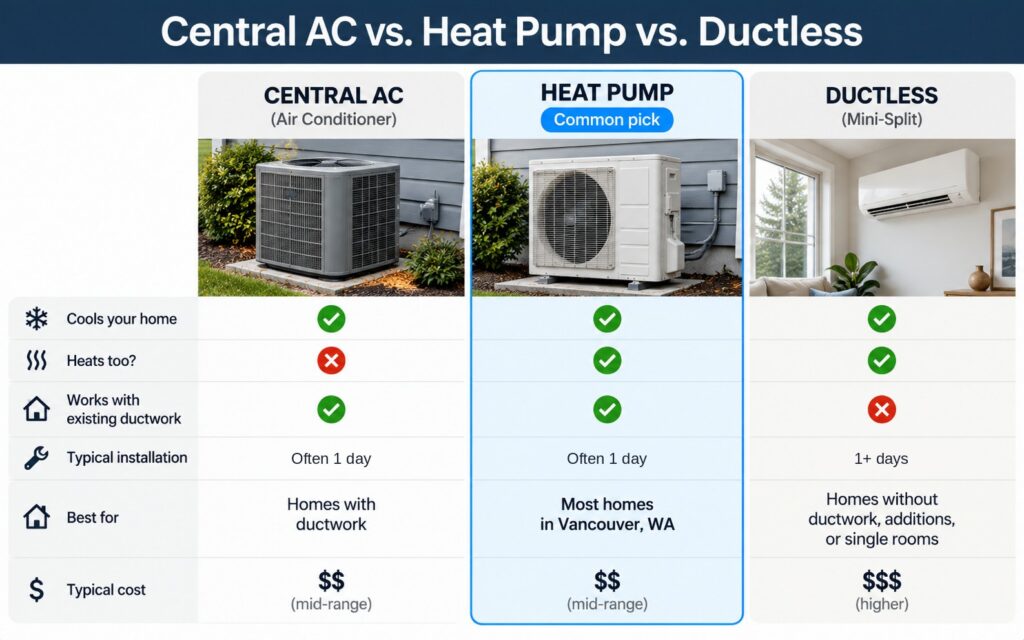
1. Central air conditioner
A central AC adds an outdoor condenser and an indoor coil to your existing furnace and ductwork.
- Best for: homes with a newer, efficient furnace and good ductwork, where you only need cooling
- Keep in mind: It cools only. If your furnace is aging, you may replace it in a few years anyway.
2. Heat pump
A heat pump looks and installs much like a central AC, but it also heats. In Vancouver's mild climate, a heat pump can take over most or all of your heating.
- Best for: most homes adding cooling, especially those with an aging furnace, electric resistance heat, or high heating bills
- Keep in mind: It can pair with your existing gas furnace as a dual-fuel system.
- Why it's often the better buy: For many homes the price difference between a heat pump and a comparable AC is modest, and a heat pump adds efficient heating. See Heat Pump vs. Furnace for local operating costs.
3. Ductless mini-split
An outdoor unit connects to one or more indoor heads mounted on walls or ceilings, with no ductwork.
- Best for: homes without ducts (common in older Vancouver homes with baseboard heat), additions, converted garages, bonus rooms, or cooling just the bedrooms
- Keep in mind: Each indoor head covers a room or zone, so whole-house coverage takes several heads. Ductless systems also heat.
How much does it cost to install air conditioning?
Every home is different, so the cost to install air conditioning comes down to a few main factors, and an honest quote requires a site visit:
- System type: central AC, heat pump or ductless
- Size (capacity): set by a load calculation, not square footage alone. See why sizing matters.
- Efficiency and features: higher SEER2 ratings and variable-speed equipment cost more upfront
- Ductwork: whether existing ducts can handle cooling airflow, or need repair, sealing or resizing
- Electrical work: a dedicated 240V circuit is typically needed, and older panels sometimes need an upgrade
- Furnace or air handler compatibility: an older furnace may not have a blower suited to AC, which may point toward replacing both
- Installation complexity: line set length, where the outdoor unit goes, and attic or crawlspace access
- Permits: installation generally requires a mechanical permit, and often an electrical one
Ways to manage the investment:
- Financing: Tri-Tech Heating, Inc. offers financing through Synchrony for qualified buyers.
- Timing: Scheduling in spring, before the first heat wave, gives you more flexibility than waiting until July.
- Incentives: The federal 25C tax credit expired December 31, 2025 (see the IRS Energy Efficient Home Improvement Credit page). Clark Public Utilities offers rebates and low-interest loans for qualifying upgrades, with eligibility depending on your current heating type. Ask when we quote, or check with Clark Public Utilities at (360) 992-3355.
Are you in need of professional services for your home’s heating systems?
Contact Tri-Tech Heating, Inc. for expert solutions today!
AC installation in Vancouver WA: from estimate to install day
1. The estimate visit. A technician looks at your home, existing equipment, ductwork and electrical panel, and calculates your cooling (and heating) load. Estimates on installations from Tri-Tech Heating, Inc. are free.
2. The proposal. You should get specific equipment model numbers, efficiency ratings, what's included, warranty terms and a timeline. Our HVAC upgrade guide has a checklist for comparing quotes.
3. Permits and scheduling. Your contractor pulls the permits and schedules your install.
4. Installation day. A typical central AC or heat pump installation includes:
- Setting the outdoor unit on a level pad or stand
- Installing or replacing the indoor coil at the furnace or air handler
- Running and connecting the refrigerant line set
- Electrical work, including a disconnect at the outdoor unit
- Connecting the condensate drain
- Pressure-testing and evacuating the lines, then charging refrigerant to specification
- Thermostat setup
- Startup and testing
Many straight installations finish in a day. Ductless systems with several indoor heads, ductwork changes or electrical upgrades can take longer.
5. After installation.
- Walk through the thermostat with the installer.
- Register the warranty.
- Keep the permit paperwork.
- Plan for annual maintenance: spring for AC, and twice a year for heat pumps. See the seasonal maintenance checklist.
Get a free estimate
Tri-Tech Heating, Inc. installs air conditioners, heat pumps and ductless systems across Vancouver, Camas, Salmon Creek and Clark, Cowlitz and Skamania Counties and the Portland metro area. We install York, American Standard and Mitsubishi equipment, and our work is 100% guaranteed.
Learn more about air conditioning installation in Vancouver WA, Camas and Salmon Creek, or contact us.
Our office is open Monday through Thursday, 8:00am to 5:00pm, and Friday, 8:00am to 4:00pm, and a call to (360) 891-2002 during those hours reaches a person. After hours, call the same number and a live person from our answering service will take your information. They'll text our on-call technician right away, or, if you'd rather wait, pass your request to our office and we'll respond by 9:00am the next business day. Licensed HVAC #TRITEHI952LL, CCB #161426.
Are you in need of professional services for your home’s heating systems?
Contact Tri-Tech Heating, Inc. for expert solutions today!
Frequently Asked Questions
Do I need a permit to add air conditioning?
Generally, yes: a mechanical permit and often an electrical one. Your contractor handles them.
How much does it cost to install air conditioning in Vancouver WA?
It depends mostly on the type of system, whether your ductwork can handle cooling, any electrical upgrades, and the size and layout of your home. Adding AC or a heat pump to an existing forced-air furnace is usually the simplest install, and homes without ducts often go ductless. We give free written estimates after a site visit.
How long does AC installation take?
Central AC or a heat pump added to existing ductwork often takes about a day. Ductless systems often take a day or more, depending on how many indoor units you need.
Company Information
Tri-Tech Heating, Inc.
6406 NE 116th Ave Unit C
Vancouver, WA 98662
Phone: (360) 891-2002