
Last updated: September 25, 2026
A heat pump fits this part of the country almost too neatly. Vancouver WA winters are cool and wet rather than severely cold, with a handful of brief hard freezes, and our summers have become warm enough that cooling is no longer optional for most households. A heat pump handles both from one system.
The technology confuses people, though, mostly because the name is misleading. A heat pump does not make heat. It moves heat, and that single distinction explains nearly everything else about how it performs and what it costs to run.
What is a heat pump and how does it work?
A furnace converts fuel or electricity into heat. A heat pump takes heat that already exists outdoors and carries it inside, which is a far cheaper thing to do. There is usable heat in outdoor air even when it feels cold to you, and a heat pump's job is to collect it, concentrate it, and release it indoors.
In summer the process runs backward: the same equipment pulls heat and humidity out of the house and dumps it outdoors, which is what an air conditioner does. A heat pump is an air conditioner that runs in both directions.
Because it is moving energy rather than creating it, a heat pump delivers more heat than the electricity it draws. In practice a modern system produces two to three times more heating energy than the electrical energy it consumes. Nothing that burns fuel can do that, because combustion equipment is limited by the energy in the fuel itself.
How does a heat pump work? The refrigeration cycle
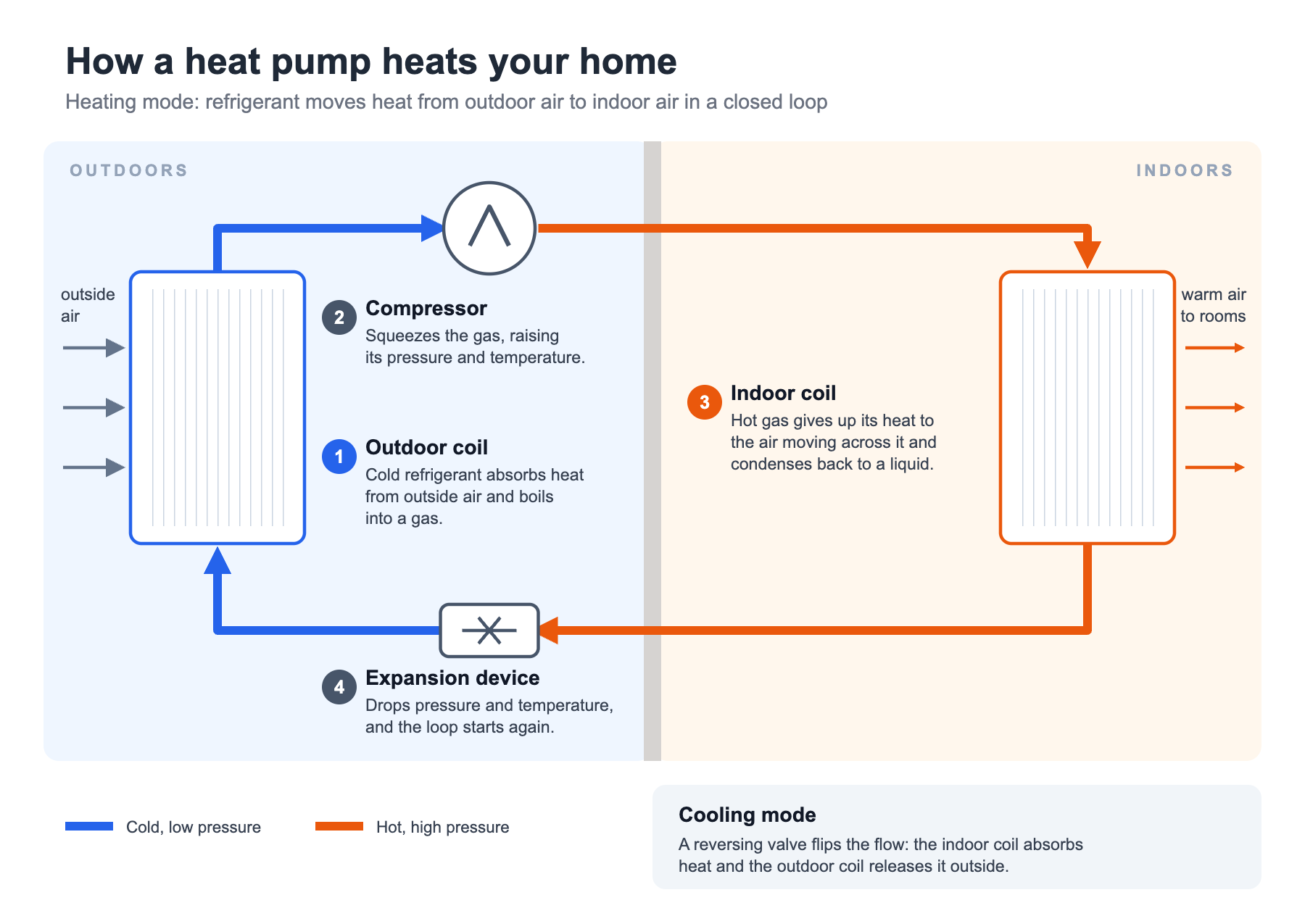
Refrigerant circulates through a closed loop and changes state as it goes. In heating mode, cold low-pressure refrigerant passes through the outdoor coil and absorbs heat from the outside air, boiling into a gas. The compressor squeezes that gas, raising its temperature and pressure sharply. The hot gas flows to the indoor coil, gives up its heat to the air moving across it, and condenses back to a liquid. An expansion device drops its pressure and temperature, and the loop starts again.
A reversing valve makes the system dual-function. Flip it and the coils trade roles: the indoor coil absorbs heat, the outdoor coil rejects it, and you have air conditioning.
Why this works well in Vancouver
The honest local argument for a heat pump is our climate, not a sales pitch. Heating equipment here spends most of its runtime in the 30s and 40s, squarely where a heat pump is efficient. Modern units extract usable heat well below freezing, and a properly sized system carries a Clark County winter on its own. Our hard freezes are short, and some systems add supplemental electric resistance heat for those stretches, which is less efficient but runs only a few hours at a time.
The summer side matters as much. Because a heat pump cools, one installation covers both seasons. In a house with no air conditioning and an aging furnace, that is the argument: you are not choosing between heating and cooling, you are buying both at once.
The main types of heat pump
They are not interchangeable, and the right one depends on your house rather than on which is newest.
- Ducted air-source heat pumps use your existing ductwork and registers. If the ducts are sound and reasonably sized, this is the most straightforward path and the least visible in the house.
- Ductless mini-splits use wall or ceiling units serving individual rooms or zones, with no ducts at all. They suit homes without ductwork, additions, converted garages, and shops, and let you condition only the rooms you use.
- Ground-source (geothermal) heat pumps exchange heat with the stable temperature of the earth rather than outdoor air, which makes them very efficient year-round. They require excavation or boring, so they are a much larger project.
- Dual-fuel or hybrid systems pair a heat pump with a gas furnace and switch between them based on outdoor temperature. The heat pump covers most of the season, the furnace takes the coldest weather.
Reading the efficiency ratings
Heat pumps carry two ratings, and both changed recently. Cooling is rated in SEER2 and EER2, heating in HSPF2. Those replaced SEER, EER, and HSPF on January 1, 2023, when the Department of Energy moved to a test procedure reflecting the real duct static pressure equipment works against.
The practical consequence: a SEER2 number is not comparable to an older SEER number. For identical equipment, SEER2 reads slightly lower, so comparing a quote against the sticker on a system installed a decade ago compares two different tests. Washington is in the DOE North region, where split-system central air conditioners under 65,000 BTU/hr must meet at least 13.4 SEER2. You will also see COP, the ratio of heat delivered to energy consumed, which is still current and is the cleanest way to see the multiple described above.
ENERGY STAR certified models meet efficiency levels above the federal minimum.
What you get out of it
One system instead of two, with one set of maintenance and one eventual replacement. Lower heating energy use, because of the efficiency multiple. No combustion in the house, which means no flue, no gas burner, and no carbon monoxide risk from the heating system. No fossil fuel burned on site, so a smaller footprint that shrinks further as the regional grid gets cleaner. With maintenance, expect roughly 15 to 20 years of service, comparable to a good furnace, from equipment that runs year-round rather than seasonally.
A note on refrigerant
The refrigerant in new equipment changed recently too. Systems manufactured from January 1, 2025 onward use lower-GWP A2L refrigerants such as R-454B. Equipment from roughly 2010 through 2024 uses R-410A, being phased down under the AIM Act, so its service cost rises over time. Anything from before about 2010 may use R-22, out of production and import since January 1, 2020 and serviceable only from reclaimed supply.
This matters mainly when replacing something old. Worth knowing either way: refrigerant is never consumed, so low charge means a leak and the leak is the repair. It is not poisonous, but it displaces oxygen in an enclosed space and can cause frostbite on contact, and federal law requires certified handling and recovery.
Incentives, as they stand now
A note on incentives: the federal 25C tax credit that covered 30% of heat pump installation costs (up to $2,000) expired on December 31, 2025. If your system was installed on or before that date, you may still claim it on your return using IRS Form 5695. For installations after that date, the federal credit is no longer available. Utility-level rebates and financing are a separate matter, and we can tell you what currently applies in Clark County when we quote your system.
Are you in need of professional services for your home’s heating systems?
Contact Tri-Tech Heating, Inc. for expert solutions today!
Installation and sizing
Sizing decides whether you are happy with the system. It comes from a load calculation based on your home's square footage, insulation, windows, and air leakage, not from the capacity of whatever was there before. An oversized heat pump short cycles, dehumidifies poorly in summer, and wears out early. An undersized one leans on backup heat.
Placement matters too: the outdoor unit needs clearance for airflow and should not sit where it will be buried in debris. Some homes need electrical work, and ductwork often needs sealing or modification, since heat pumps deliver warm air at a lower temperature than a furnace and therefore move more of it.
Maintenance that keeps the efficiency
Change or clean filters every one to three months, and keep the outdoor unit clear of leaves, grass clippings, and snow on all sides. Have the coils cleaned and the system checked once a year, including charge, electrical connections, and the defrost cycle. Seal duct leaks when you find them, since heated air lost into a crawlspace is heat you paid to move. For a full checklist of what a professional visit covers, see Heat Pump Maintenance in Vancouver WA: What a Tune-Up Includes.
Heat Pump Installation in Vancouver WA
Tri-Tech Heating, Inc. installs and services ducted and ductless heat pumps across Vancouver, Camas, Salmon Creek, and Clark, Cowlitz and Skamania Counties and the Portland metro area. We run a load calculation on your house before recommending equipment, and we will tell you when a heat pump is not the right answer.
Our office is open Monday through Thursday, 8:00am to 5:00pm, and Friday, 8:00am to 4:00pm, and a call to (360) 891-2002 during those hours reaches a person. The office is closed on Memorial Day, July 4, Labor Day, Thanksgiving and the day after, Christmas Eve, Christmas Day and New Year’s Day. After hours and on holidays, call the same number and a live person from our answering service will take your information. They'll text our on-call technician right away, or, if you'd rather wait, pass your request to our office and we'll respond by 9:00am the next business day. You can also contact us to arrange an estimate. Licensed HVAC #TRITEHI952LL, CCB #161426.
Are you in need of professional services for your home’s heating systems?
Contact Tri-Tech Heating, Inc. for expert solutions today!
Frequently Asked Questions
Will a heat pump keep my house warm during a Vancouver cold snap?
Yes, if it is sized correctly. Modern heat pumps pull usable heat from outdoor air well below freezing, and our hard freezes are brief. Some systems add electric resistance heat as backup for the coldest hours, and cold-climate models extend the range further.
Can I still get a federal tax credit for a heat pump?
No. The 25C credit expired on December 31, 2025, and it does not apply to installations completed after that date. If yours was installed on or before that date you may still be able to claim it using IRS Form 5695. Ask us about current utility rebates and financing when we quote.
Do I need ductwork for a heat pump?
Not necessarily. A ducted system uses existing ducts, but ductless mini-splits need none, which makes them practical for older homes, additions, and converted spaces. Which one fits depends on your house, not on which is newer technology.
Why does my heat pump blow air that feels cooler than my furnace did?
Because it does, and that is normal. A heat pump delivers a larger volume of air at a lower temperature, so supply air feels less hot on your skin even while the house holds the same setpoint. Most people stop noticing after a few weeks.
Does a heat pump replace my air conditioner too?
Yes. A heat pump cools in summer exactly as an air conditioner does, using the same refrigeration cycle in reverse. If you install one, you do not need a separate cooling unit.
What are the downsides of a heat pump?
The main tradeoffs are upfront cost, backup heat in a hard freeze, and cooler-feeling supply air. A heat pump typically costs more to install than a furnace alone, though it replaces both the furnace and the air conditioner. During a hard freeze some systems lean on electric resistance backup heat, which is less efficient, but our freezes are brief. And supply air feels less hot than furnace air, which most people stop noticing after a few weeks.
Company Information
Tri-Tech Heating, Inc.
6406 NE 116th Ave Unit C
Vancouver, WA 98662
Phone: (360) 891-2002