
Last updated: September 27, 2026
When homeowners shop for a new heating or cooling system, most of the attention goes to brand and efficiency rating. But two things decide how the system actually performs in your home for the next 15 years: whether it's the right size and whether it's installed correctly. A premium system that's oversized or poorly installed can run less efficiently, less comfortably and less reliably than a mid-range system done right.
Short answer: The right size comes from a Manual J load calculation, not square footage or your old unit's size. An oversized system short cycles, wears out faster and controls humidity poorly, and a careful installation matters as much as the equipment itself.
Why size matters
Heating and cooling equipment is rated by capacity: BTUs per hour for furnaces, and tons for heat pumps and air conditioners, with 1 ton equal to 12,000 BTUs per hour. The goal is to match that capacity to how much heat your home gains and loses on a typical design day.
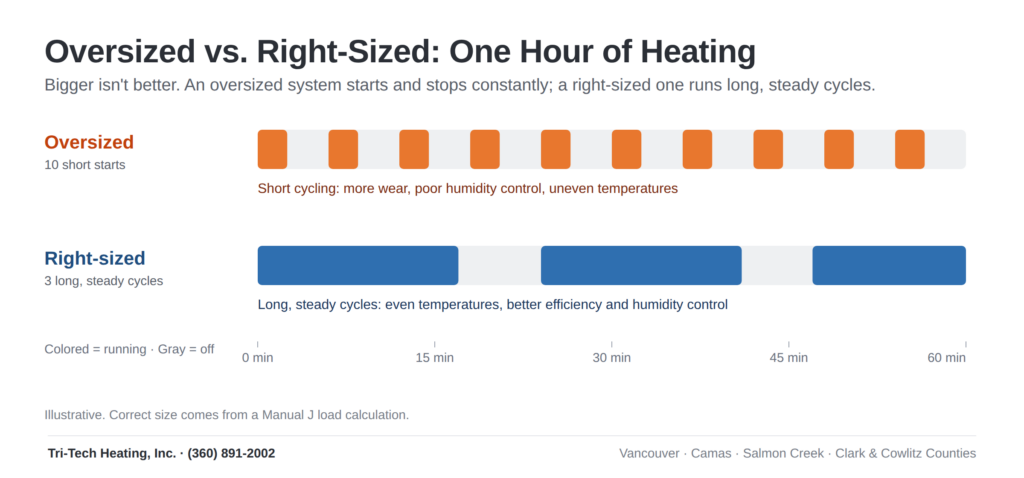
An oversized system:
- Short cycles: it heats or cools the space quickly, shuts off, and starts again, over and over
- Wears out components faster, since starting up is the hardest part of each cycle
- Leaves uneven temperatures, with hot and cold spots
- Controls humidity poorly in cooling mode, because short cycles don't run long enough to pull moisture out of the air
- Costs more to buy and often more to run
An undersized system:
- Runs constantly on the hottest and coldest days and still can't keep up
- With a heat pump, leans heavily on costly backup electric heat
"Bigger is better" is one of the most common, and most expensive, assumptions in HVAC.
How sizing is actually done
The industry standard is a load calculation, commonly called a Manual J, from the Air Conditioning Contractors of America (ACCA). It accounts for:
- Square footage and ceiling heights
- Insulation levels in walls, attic and floors
- Window size, type and which direction they face
- Air leakage
- Local climate and design temperatures
- How many people live there, and heat from appliances
Related ACCA methods cover equipment selection (Manual S), choosing a specific model that matches the calculated load, and duct design (Manual D), making sure the ductwork can deliver the right airflow to each room.
What sizing is not:
- A rule of thumb by square footage. Two 2,000-square-foot homes can have very different loads.
- "Same size as the old one." The old system may have been oversized from the start, and upgrades since then, like new windows, insulation or an addition, change the load.
What a quality installation includes
Correct size is half the job. Installation quality is the other half. A professional installation should include:
- Proper refrigerant charge for heat pumps and AC, set to the manufacturer's specifications and verified with measurements, not guesswork
- Correct airflow, so the blower moves the right amount of air for the equipment, and duct static pressure is checked
- Sealed, well-connected ductwork, with connections and leaks sealed, especially in crawlspaces and attics
- Clean, properly brazed refrigerant lines, purged with nitrogen during brazing and pulled to a deep vacuum before charging, to keep moisture and contaminants out of the system
- Correct venting for gas furnaces, including properly sloped PVC on high-efficiency models, a condensate drain and correct termination outside
- Safe electrical work, with correct circuit and breaker sizing and a disconnect at the outdoor unit
- A level, stable base for outdoor units, with proper clearance and elevation for drainage
- Thermostat setup matched to the equipment, including auxiliary heat lockout for heat pumps
- Startup and testing: verifying temperatures, pressures, combustion (on gas equipment) and safety controls before leaving
- Permits and inspection, since HVAC replacement generally requires a mechanical permit
Common HVAC installation mistakes (DIY and pro)
These are the common HVAC mistakes we see most often, on DIY HVAC projects and on rushed professional jobs alike:
- Sizing by the old unit or square footage instead of a load calculation
- Reusing old ductwork without checking it, so leaks and undersized runs strangle a new system
- Improper refrigerant charge, which cuts efficiency and capacity and shortens compressor life
- Skipping the vacuum and nitrogen purge on refrigerant lines, leaving moisture and contamination that damage the system over time
- Poor venting or drainage on high-efficiency furnaces, which can lead to shutdowns, water damage or safety issues
- No permit, which can create problems with insurance, warranties and resale, and means no inspection
- Voided warranties, since many manufacturers require professional installation and registration
Why HVAC is a poor DIY project:
- Handling refrigerant requires EPA certification.
- Gas and electrical work carry real safety risks.
- Manufacturer warranties typically depend on professional installation.
Changing filters and keeping the outdoor unit clear is homeowner work. Installation isn't.
Are you in need of professional services for your home’s heating systems?
Contact Tri-Tech Heating, Inc. for expert solutions today!
How Tri-Tech approaches installation
Tri-Tech Heating, Inc. calculates your home's heating and cooling load before recommending equipment, checks your ductwork and electrical service, and installs to the manufacturer's specifications. We install York, American Standard and Mitsubishi equipment, estimates on installations are free, and our work is 100% guaranteed.
For the bigger picture on choosing and comparing systems, see our HVAC upgrade guide and Heat Pump vs. Furnace.
Talk to us before you buy
Tri-Tech Heating, Inc. serves Vancouver, Camas, Salmon Creek and Clark and Cowlitz Counties. Learn more about HVAC installation in Vancouver WA, or contact us for a free estimate.
Our office is open Monday through Friday, 8:00am to 5:00pm, and a call to (360) 891-2002 during those hours reaches a person. After hours, call the same number and a live person from our answering service will take your information. They'll text our on-call technician right away, or, if you'd rather wait, pass your request to our office and we'll respond by 9:00am the next business day. Licensed HVAC #TRITEHI952LL, CCB #161426.
Are you in need of professional services for your home’s heating systems?
Contact Tri-Tech Heating, Inc. for expert solutions today!
Frequently Asked Questions
How do I know if my system was installed correctly?
Signs of problems include short cycling, uneven temperatures, high bills, weak airflow or frequent breakdowns on newer equipment. A technician can check refrigerant charge, airflow and static pressure.
Can I install my own HVAC system?
Some DIY HVAC tasks are fine for homeowners: changing filters, keeping the outdoor unit clear and swapping a basic thermostat. Installing or replacing equipment generally needs a mechanical permit and often an electrical one, and anyone who connects or charges refrigerant lines must hold EPA Section 608 certification. Wrong sizing, refrigerant charge and airflow are the most common problems we find on DIY HVAC systems.
Company Information
Tri-Tech Heating, Inc.
6406 NE 116th Ave Unit C
Vancouver, WA 98662
Phone: (360) 891-2002